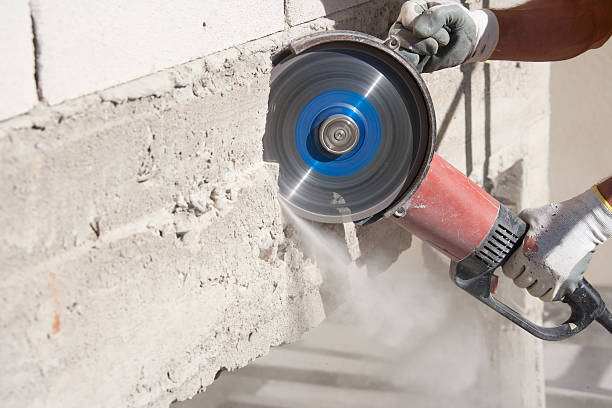
Concrete demolition and modification require specialized equipment and skilled workers to achieve safe, precise results. Property owners may need concrete cutting for structural modifications, utility installations, and surface preparation. Contractors use several concrete cutting methods in Cedar Rapids, IA, depending on the project’s requirements.
Specialists commonly use diamond blades to make precise cuts while limiting unnecessary vibration and disturbance to surrounding materials. This guide explains common concrete cutting methods, the equipment used, and their applications in the Cedar Rapids, IA, area.
What Methods Are Used for Concrete Cutting in Cedar Rapids, IA?
The most common methods used for concrete cutting are slab sawing, wall sawing, core drilling, and wire sawing. The appropriate cutting technique depends on the required cut depth and shape, concrete thickness, reinforcement, access, and site conditions.
When Is Slab Sawing Used?
For slab sawing, a walk-behind or ride-on saw is used with a diamond blade. These saws are designed to make horizontal cuts in concrete floors, pavements, bridge decks, and slabs. Typical cut depths range from 2 to 24 inches depending on blade diameter and equipment. This method produces precise cuts for creating expansion joints, utility trenches, or sections of concrete that need to be removed. Slurry generated during wet slab sawing must be contained and disposed of in compliance with local requirements, as it cannot be allowed to enter storm drains.
When Is Wall Sawing or Wire Sawing Applied?
Wall sawing is used when it is necessary to form accurate vertical and horizontal cuts on concrete walls using a track-mounted diamond blade. It is commonly used to create wall openings for doors, windows, and mechanical systems or to remove sections of concrete. Wall saws can typically reach cut depths of 24 to 30 inches in a single pass, depending on blade size. For confined areas or cuts where a track-mounted saw cannot be positioned, a ring saw offers a depth advantage over a standard handheld cut-off saw, which is generally limited to around 4 to 5 inches per pass.
When Is Wire Sawing Used?
Wire sawing uses a continuous loop of diamond-impregnated wire and is well suited to cutting thick or heavily reinforced concrete. It is often used when conventional saw blades cannot reach the required cutting depth or when the concrete section is too large for conventional sawing equipment. Wire sawing has no practical depth limit, making it the preferred method for cutting large bridge sections, dam structures, or mass concrete where other equipment cannot operate.
When Is Core Drilling Used?
Core drilling uses a hollow diamond-tipped bit to cut cylindrical openings in concrete slabs, walls, and foundations. It is the most commonly requested concrete cutting service for utility and mechanical work, used to create clean, circular penetrations for plumbing pipes, electrical conduit, HVAC sleeves, and anchor bolt installations. Core bits range from less than an inch to several feet in diameter, and drilling can be performed in horizontal, vertical, or angled orientations depending on site conditions.
What Tools and Equipment Are Used for Professional Concrete Cutting?
Professional concrete cutting commonly uses diamond blades, core bits, concrete saws, core drills, water-delivery systems, and dust-control equipment. Tool selection depends on concrete thickness and reinforcement, site access, the required cut, and the desired finish.
Diamond tooling is widely used because diamond segments can cut reinforced and high-strength concrete effectively. Bond hardness of the diamond segments is selected based on aggregate hardness. It is because softer bonds release diamonds faster in hard aggregate, while harder bonds are used in softer concrete to extend blade life. Depending on the application, equipment may include handheld cut-off saws, ring saws, slab saws, wall saws, wire saws, and core drills.
Wet-cutting methods can help control airborne dust during concrete cutting, including dust that may contain respirable crystalline silica. The OSHA Respirable Crystalline Silica Standard for Construction (29 CFR 1926.1153) specifies engineering controls for cutting operations, including the use of water delivery systems or vacuum dust collection at the point of cut. For wet sawing operations, the standard identifies continuous water application as a listed control method. Applying water at the cutting point suppresses airborne dust during sawing and also generates slurry that must be collected and disposed of properly.
What Are the Common Applications of Concrete Cutting?
Concrete cutting applications depend on the type of modification, the structure, and the conditions at the work site. Before work begins, contractors typically evaluate the concrete dimensions, reinforcement, nearby utilities, site accessibility, and planned cutting sequence. Ground-penetrating radar (GPR) scanning is used to locate reinforcing steel, post-tension cables, conduit, and other embedded elements prior to cutting. GPR is particularly critical for post-tensioned slabs, where cutting an undetected tendon can cause a sudden and dangerous release of tension. Identifying these elements before cutting is what separates a qualified concrete cutting contractor from one who simply operates a saw.
Common concrete cutting applications include:
- Creating openings for doors, windows, and mechanical systems
- Cutting concrete slabs for plumbing and electrical installations
- Removing damaged sections of concrete pavement
- Creating expansion and construction joints
- Creating penetrations for utility lines
- Concrete removal as part of structural demolition
For reinforced concrete structures, contractors should identify reinforcement and nearby utilities through GPR scanning prior to cutting. Structural modifications may also require evaluation of load paths and temporary supports to be completed before cutting begins.
Planning Your Concrete Cutting Project in Cedar Rapids, IA?
Selecting the right concrete cutting methods in Cedar Rapids, IA, involves more than choosing the appropriate saw and blade. The process also depends on the condition of the structure, required cut depth, reinforcement, site accessibility, and project goals. Using the appropriate equipment and silica-control measures in line with OSHA 29 CFR 1926.1153 can help contractors make precise cuts while maintaining safer working conditions.
Tasks such as core drilling, slab sawing, wall opening cuts, and pavement cutting require careful planning and GPR scanning before work begins. Contact a qualified concrete cutting contractor in Cedar Rapids, IA, to discuss your project requirements and plan the work.